Next.js SEO Guide: Programmatic Content for Developers
Modern product teams ship React fast, but SEO work lags behind. Manual metadata, schemas, and publishing rules do not scale.
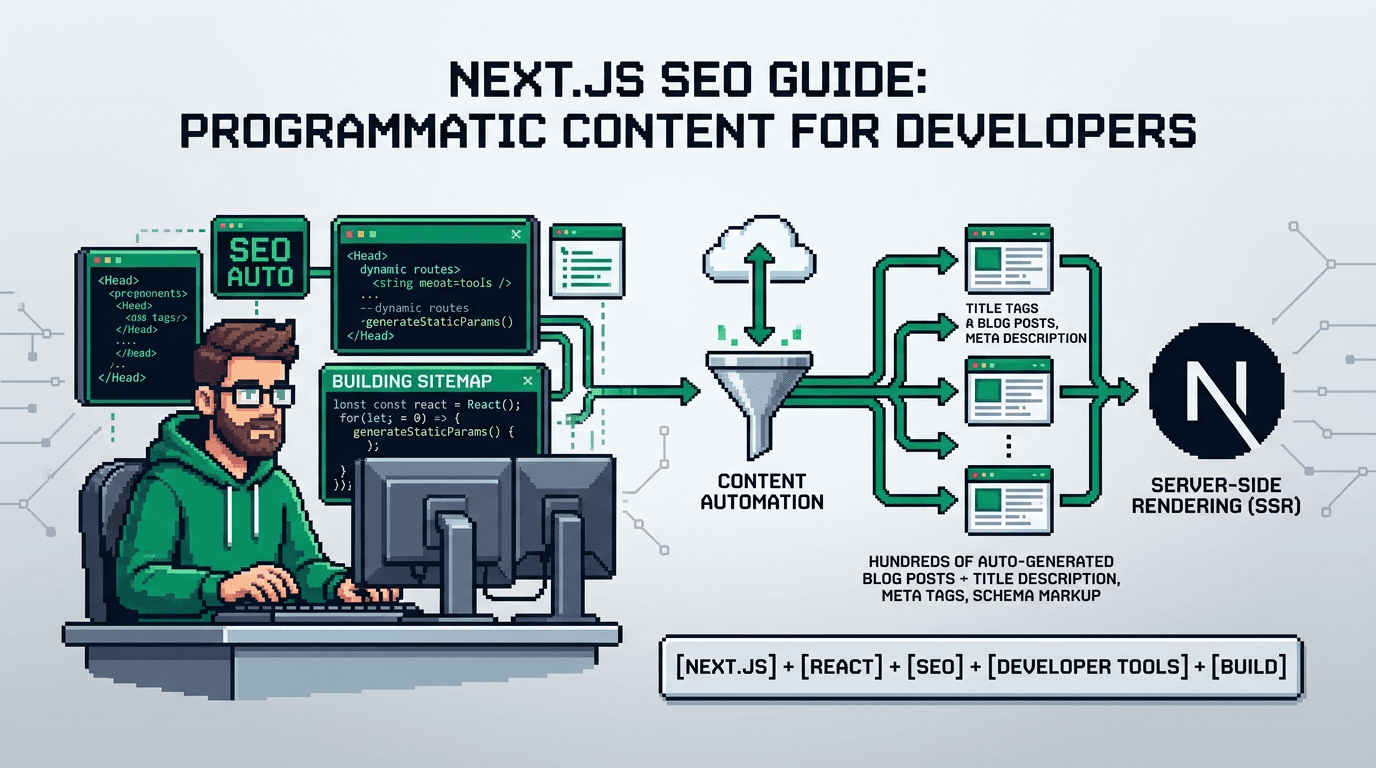
This guide shows developers how to implement programmatic SEO in Next.js: automated metadata, schema markup, sitemaps, internal linking, and a reliable publishing workflow. It is for React and Next.js teams who want SSR-friendly, search-ready content without a traditional CMS. Key takeaway: treat SEO as code and wire an automated pipeline that enforces execution on every post.
What is programmatic SEO and why it fits Next.js
Programmatic SEO is the practice of generating many high quality pages from structured inputs, then enforcing metadata, schemas, internal links, and sitemaps automatically. In Next.js, the app and build layers give you hooks to codify these rules.
Core benefits for React and SSR apps
- Consistent metadata and schema across thousands of pages
- Faster time to publish with fewer manual steps
- Safer refactors since SEO is enforced by code
- Easier experimentation with templates and components
Typical inputs and outputs
- Inputs: product catalogs, feature flags, location data, FAQs, docs, changelogs, CMS or JSON feeds
- Outputs: pages with deterministic titles, descriptions, structured data, sitemaps, and internal links
Next.js SEO fundamentals you should codify
Before automating, standardize the core rules your app will apply at render time.
Titles and descriptions as functions
Define functions that map data to concise titles and descriptions. Keep titles under 60 characters when possible and descriptions near 155 characters.
Canonicals and robots
Render a canonical URL for every page and a robots tag that matches your indexation policy. Guard against duplicates and parameter noise.
Open Graph and Twitter metadata
Generate social metadata from the same source as your HTML meta. Use fallbacks for images and avoid missing fields that break link previews.
A practical Next.js SEO setup with the Metadata API
Next.js exposes a Metadata API that centralizes core tags. Use it to encode your SEO rules.
Project scaffold and files
- app/ layout.tsx for sitewide metadata and defaults
- app/[segment]/ page.tsx for route-level overrides
- app/sitemap.ts and app/robots.ts for machine-readable outputs
Example: typed metadata helpers
// lib/seo.ts
export type SeoInput = {
  slug: string;
  title: string;
  description: string;
  canonical: string;
  image?: string;
};

export function toOpenGraph(input: SeoInput) {
  return {
    title: input.title,
    description: input.description,
    images: input.image ? [input.image] : [],
    url: input.canonical,
    siteName: 'YourApp',
  } as const;
}

export function toTwitter(input: SeoInput) {
  return {
    card: 'summary_large_image',
    title: input.title,
    description: input.description,
    images: input.image ? [input.image] : [],
  } as const;
}
// app/[slug]/page.tsx
import { Metadata } from 'next';
import { toOpenGraph, toTwitter } from '@/lib/seo';
import { getPostBySlug } from '@/lib/data';
export async function generateMetadata({ params }: { params: { slug: string } }): Promise<Metadata> {
const post = await getPostBySlug(params.slug);
const canonical = `https://example.com/blog/${post.slug}`;
return {
title: post.title,
description: post.description,
alternates: { canonical },
openGraph: toOpenGraph({ slug: post.slug, title: post.title, description: post.description, canonical, image: post.image }),
twitter: toTwitter({ slug: post.slug, title: post.title, description: post.description, canonical, image: post.image }),
robots: { index: true, follow: true },
};
}Programmatic content patterns that scale
Templates let you generate many pages while preserving quality.
Data driven page templates
- Location or vertical pages built from a dataset
- Feature comparisons generated from a spec matrix
- API or docs references hydrated from OpenAPI or MDX
Guardrails and validation
- Enforce title and description length at build time
- Validate required schema properties
- Fail builds when canonical or slug conflicts occur
// lib/validate.ts
export function assertSeo(shape: { title: string; description: string; canonical: string }) {
  if (!shape.title || shape.title.length > 60) throw new Error('Invalid title');
  if (!shape.description || shape.description.length > 160) throw new Error('Invalid description');
  if (!shape.canonical.startsWith('https://')) throw new Error('Invalid canonical');
}
Structured data: schemas that move the needle
Programmatic SEO content benefits from consistent structured data rendered as JSON-LD.
Common schemas for blogs and docs
- Article and BlogPosting for editorial posts
- FAQPage and HowTo for procedural content
- Product and SoftwareApplication for SaaS feature and pricing pages
Rendering JSON LD safely
// components/JsonLd.tsx
export function JsonLd({ json }: { json: Record<string, any> }) {
  return <script type="application/ld+json" dangerouslySetInnerHTML={{ __html: JSON.stringify(json) }} />;
}
// app/blog/[slug]/page.tsx (snippet)
import { JsonLd } from '@/components/JsonLd';
function ArticleLd({ post }: { post: any }) {
const data = {
'@context': 'https://schema.org',
'@type': 'BlogPosting',
headline: post.title,
description: post.description,
datePublished: post.publishedAt,
dateModified: post.updatedAt ?? post.publishedAt,
author: { '@type': 'Organization', name: 'Your Company' },
mainEntityOfPage: { '@type': 'WebPage', '@id': `https://example.com/blog/${post.slug}` },
};
return <JsonLd json={data} />;
}Sitemaps, robots, and revalidation
Get discovery and freshness right with machine readable endpoints.
Dynamic sitemap generation
// app/sitemap.ts
import { MetadataRoute } from 'next';
import { listPublishedPosts } from '@/lib/data';

export default async function sitemap(): Promise<MetadataRoute.Sitemap> {
  const posts = await listPublishedPosts();
  return [
    { url: 'https://example.com/', changeFrequency: 'daily', priority: 1 },
    ...posts.map(p => ({ url: `https://example.com/blog/${p.slug}`, lastModified: p.updatedAt || p.publishedAt })),
  ];
}
Robots and crawl rules
// app/robots.ts
import { MetadataRoute } from 'next';

export default function robots(): MetadataRoute.Robots {
  return {
    rules: [{ userAgent: '*', allow: '/' }],
    sitemap: 'https://example.com/sitemap.xml',
  };
}
Internal linking and navigation signals
Internal links distribute authority across your programmatic SEO content.
Deterministic related links
- Compute related posts by tag or entity and render consistent link blocks
- Add previous and next navigation for long series
Automated link components
// components/RelatedPosts.tsx
import Link from 'next/link';

export function RelatedPosts({ posts }: { posts: { slug: string; title: string }[] }) {
  if (!posts.length) return null;
  return (
    <aside aria-label="Related posts">
      <h3>Related</h3>
      <ul>
        {posts.map(p => (
          <li key={p.slug}><Link href={`/blog/${p.slug}`}>{p.title}</Link></li>
        ))}
      </ul>
    </aside>
  );
}
A minimal programmatic pipeline for Next.js
Apply governance so every page meets your rules before publish.
Source, transform, validate
1) Source content from datasets, MDX, or APIs
2) Transform into typed page models
3) Validate SEO metadata, schema, and internal link presence
Publish and revalidate predictably
- Queue drafts and approvals
- On publish, write JSON or MDX, commit to main, trigger Next.js build or ISR revalidate
- Verify sitemap and robots endpoints contain the new URL
Comparing common approaches for a Next.js blog
Here is a quick view of typical choices and tradeoffs.
| Approach | Storage | SEO control | Publishing speed | Best for |
|---|---|---|---|---|
| MDX in repo | Files | High via code | Medium | Developer blogs with versioning |
| Headless CMS | API | Medium to high | High | Content teams with workflows |
| Programmatic dataset | DB or JSON | Very high | Very high | Large catalogs and SEO templates |
Programmatic SEO examples you can ship this week
Concrete scenarios to adapt in your app.
City level integration pages
If you run a SaaS with region coverage, generate city pages with consistent titles, canonical URLs, map blocks, and local FAQs. Ensure a parent hub links to each city.
Feature comparison templates
Render A vs B pages from a spec map. Keep claims factual and cite product docs. Structure with Comparison, Use cases, Pricing model, and Alternatives.
Automating end to end with a developer first toolchain
You can hand roll everything or adopt a tool that enforces these rules for you.
What to require from an automation layer
- Built in metadata, schema, and sitemap generation
- Deterministic outputs for titles, descriptions, and canonicals
- Internal linking blocks and related post graphs
- Zero touch draft to schedule to publish workflows
Example: wiring a drop in SDK in Next.js
// app/blog/[slug]/page.tsx
import { BlogPost, fetchBlogPost, generatePostMetadata } from '@autoblogwriter/sdk/react';

export async function generateMetadata({ params }: { params: { slug: string } }) {
  return await generatePostMetadata(params.slug);
}

export default async function Page({ params }: { params: { slug: string } }) {
  const post = await fetchBlogPost(params.slug);
  return <BlogPost post={post} />;
}
Performance and UX checkpoints
Technical SEO is tightly coupled with performance and accessibility.
Rendering and speed
- Prefer server components for content pages
- Use next/image with explicit sizes and modern formats
- Defer non critical scripts and inline above the fold CSS conservatively
Accessibility and semantics
- One H1 in the article body, logical H2 and H3 hierarchy
- Descriptive link text, alt text for images
- High contrast and focus states for interactive elements
Testing and monitoring
Catch regressions before they impact traffic.
Pre merge checks
- Unit test metadata helpers and schema outputs
- Lint for missing canonicals and duplicate slugs
- Validate JSON LD with a schema validator in CI
Post deploy verification
- Fetch sitemap and spot check URLs
- Use server logs to confirm crawl of new pages
- Track indexation status and coverage trends
Frequently used utilities
Helpful snippets that repeat across projects.
Slug and canonical helpers
export function toSlug(input: string) {
  return input.toLowerCase().replace(/[^a-z0-9]+/g, '-').replace(/(^-|-$)/g, '');
}

export function toCanonical(path: string) {
  const base = 'https://example.com';
  return `${base}${path.startsWith('/') ? '' : '/'}${path}`;
}
Safe excerpt generator
export function toExcerpt(text: string, max = 160) {
  const clean = text.replace(/\s+/g, ' ').trim();
  return clean.length <= max ? clean : `${clean.slice(0, max - 1)}…`;
}
Putting it all together: a repeatable cadence
Combine the pieces into an operating model.
Weekly cycle
- Plan data inputs and page templates
- Generate drafts programmatically
- Review diffs and approve
- Publish and revalidate
- Monitor and iterate
Metrics to watch
- Pages shipped per week
- Valid schema coverage
- Internal link density and depth
- Time to index new URLs
Key Takeaways
- Treat SEO as code in Next.js using the Metadata API and typed helpers
- Programmatic SEO content scales when guardrails validate titles, canonicals, schema, and links
- Automate sitemaps, robots, internal linking, and publishing with a governed pipeline
- Monitor schema validity, index coverage, and performance to prevent regressions
Ship small, verify often, and let your automated pipeline do the heavy lifting.
Frequently Asked Questions
- What is the primary keyword for this guide?
- The primary keyword is nextjs seo.
- Do I need a CMS to implement programmatic SEO in Next.js?
- No. You can use MDX or datasets in repo, a headless CMS, or a programmatic data source with validations.
- How do I prevent duplicate content across many pages?
- Render a canonical URL for each page, enforce unique slugs, and validate duplicates during build.
- Which schemas should I start with for a blog?
- Begin with BlogPosting or Article, then add FAQPage or HowTo where the content matches the schema intent.
- How do I keep social previews consistent?
- Generate Open Graph and Twitter metadata from the same source as your HTML meta and set image fallbacks.