How to Find Programmatic SEO Examples for Next.js Sites
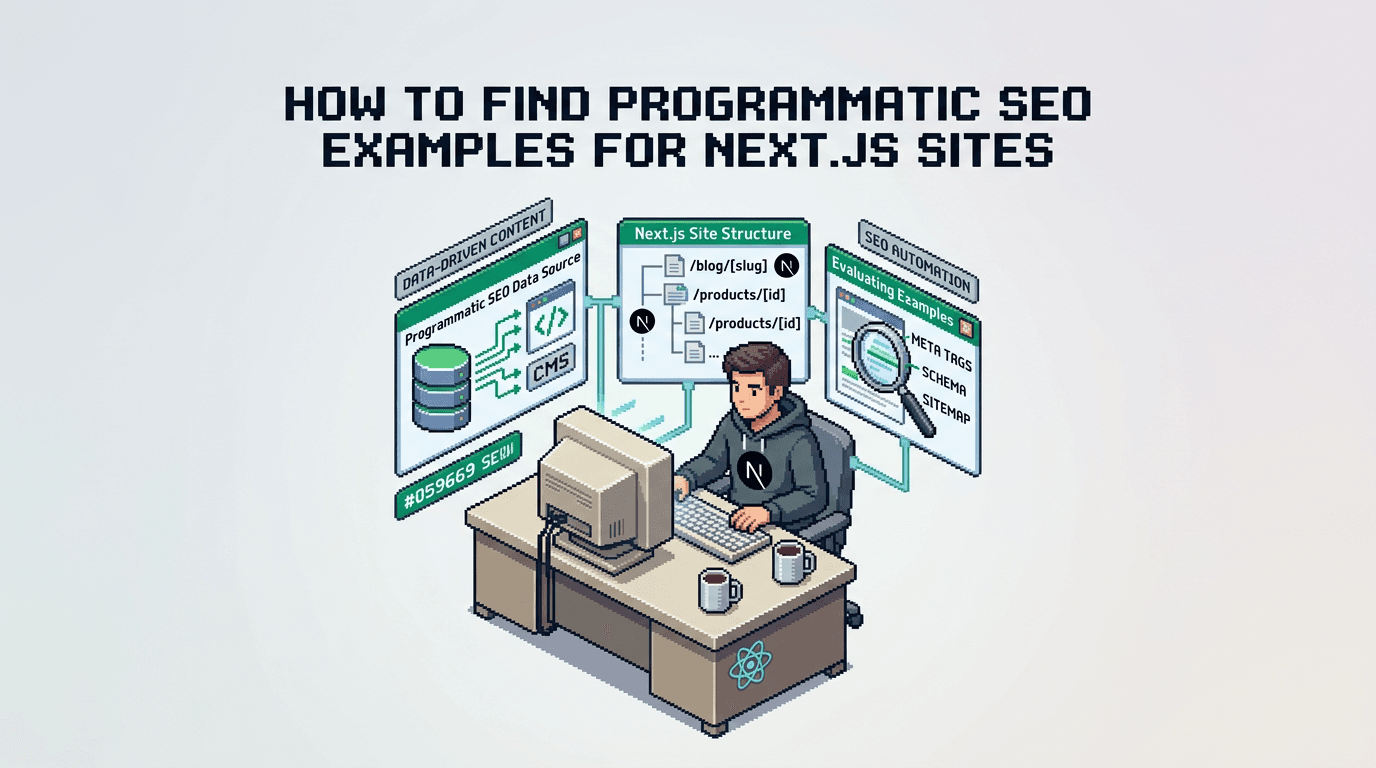
Programmatic SEO can turn a long tail of similar queries into predictable, compounding traffic. If you are building with Next.js, the challenge is finding solid examples that map to SSR, metadata, schema, and internal linking at scale.
This guide shows developers how to locate, evaluate, and replicate programmatic SEO examples specifically for Next.js projects. It covers research methods, architecture patterns, evaluation checklists, anti-patterns to avoid, and a minimal working implementation. The key takeaway: treat examples as patterns, not templates, and enforce SEO execution in your pipeline.
What counts as a strong programmatic SEO example
A strong example is more than a large set of near-duplicate pages. It is a repeatable pattern that pairs structured data with reliable rendering, metadata, and internal links.
Hallmarks of a high quality example
- Clear entity template: one schema-driven page type repeated across many entities
- Unique value per page: not just text spin, but real attributes, data, or comparisons
- Consistent metadata: titles, descriptions, canonicals, and structured data fields
- Crawlable linking: hub pages and facet links that knit the set together
- Stable URLs: predictable slugs with slug parity across internal references
Red flags that suggest a weak example
- Boilerplate pages with thin or identical content
- Wildly inconsistent titles, missing canonicals, or duplicated H1 patterns
- Pagination loops with no clear hubs or index pages
- Random parameter URLs indexed without canonical control
- No updated dates, no freshness signals, and broken internal links
How to find programmatic SEO examples in the wild
Finding examples is mostly pattern spotting across SERPs, sitemaps, and code footprints.
Use query operators to surface entity templates
- Try queries like: site:example.com inurl:/cities/ or inurl:/compare/
- Search “best X for Y” where X and Y vary by entity category
- Pair with “site:docs.*” to spot dev-driven pattern libraries
Inspect sitemaps and URL taxonomies
- Locate /sitemap.xml and any child sitemaps for categories and items
- Note consistent slug shapes like /templates/[type]/[slug]
- Compare update frequency and size to gauge automation
Analyze internal linking and hubs
- Find list pages that link to many child pages of the same type
- Check for breadcrumb schema and category hubs
- Verify that related items link laterally, not just up and down
Read source and headers for SSR clues
- Look for server rendered HTML with stable meta tags
- Check for dynamic <link rel="canonical"> and structured data
- Use curl or your browser devtools to confirm no JS-only rendering for critical SEO elements
Evaluating examples with a Next.js specific checklist
Programmatic SEO succeeds when the content system and the delivery layer agree on structure.
Rendering model and data pipeline
- Data source: JSON, CSV, headless CMS, or database with typed fields
- Build strategy: SSG with ISR, SSR for freshness, or hybrid
- Idempotency: can you rebuild a page without changing URLs or breaking links
Metadata, schema, and indexing controls
- Title and description derived from the entity, not generic strings
- Canonical logic for variants and near duplicates
- JSON-LD schema that matches the entity type and required properties
Internal linking and hub structure
- Category indexes with pagination and filters
- Related entities section generated from the same data model
- Breadcrumbs that reflect the content hierarchy
Operational concerns
- Monitoring for broken links and schema validation errors
- Rate limit safe rebuilds and revalidation
- Rollback paths if a template change introduces regressions
Common programmatic templates that work well in Next.js
These patterns recur across successful implementations and map well to file-based routing.
Directory or location based pages
- Format: /locations/[city]/[service]
- Data: city attributes, service attributes, regional compliance notes
- Schema: LocalBusiness, Service, or Place with geo and address data
Comparison matrices
- Format: /compare/[tool-a]-vs-[tool-b]
- Data: structured features and specs, pricing, categories
- Schema: Product or SoftwareApplication with aggregate ratings when available
Alternatives and best-of lists
- Format: /alternatives/[brand] or /best/[category]/[use-case]
- Data: ranked list with selection criteria and links to detailed pages
- Schema: ItemList with ListItem entries referencing entity pages
Glossary or concept entities
- Format: /glossary/[term]
- Data: definition, related terms, code examples
- Schema: DefinedTerm and breadcrumb structured data
How to replicate examples responsibly without scraping thin content
Replication does not mean copying text. It means adopting a template pattern while supplying unique value.
Sources of unique value developers can produce
- Aggregated specs from your own product or public docs you maintain
- Benchmarks you run, with reproducible methods and code
- Integration instructions, code samples, or API examples
- Curated references, changelogs, or version diffs
Guardrails to protect quality and index health
- Do not publish empty fields; enforce required attributes
- Set noindex on insufficiently complete pages until they pass validation
- Use canonicals on near duplicates and consolidate weak variants
- Create hubs before long tail pages so crawlers can discover them in context
Minimal Next.js implementation for programmatic SEO content
Below is a lightweight pattern for a typed entity template using the App Router. It covers data fetching, metadata, schema, and internal linking.
Directory structure
- app
- entities
- [slug]
- page.tsx
- schema.ts
- metadata.ts
- [slug]
- entities
- page.tsx
- entities
Example data model
// lib/types.ts
export type Entity = {
  slug: string;
  name: string;
  category: string;
  summary: string;
  specs: Record<string, string | number>;
  updatedAt: string;
  canonical?: string;
};
Page and metadata
// app/entities/[slug]/metadata.ts
import { getEntity } from "@/lib/data";

export async function generateMetadata({ params }: { params: { slug: string } }) {
  const entity = await getEntity(params.slug);
  const title = `${entity.name} specs and details`;
  const description = entity.summary.slice(0, 155);
  const canonical = entity.canonical ?? `https://example.com/entities/${entity.slug}`;

  return {
    title,
    description,
    alternates: { canonical },
    openGraph: { title, description, url: canonical, type: "article" },
    robots: { index: true, follow: true },
  };
}
// app/entities/[slug]/schema.ts
import type { Entity } from "@/lib/types";
export function entitySchema(entity: Entity) {
return {
"@context": "https://schema.org",
"@type": "SoftwareApplication",
name: entity.name,
applicationCategory: entity.category,
description: entity.summary,
url: `https://example.com/entities/${entity.slug}`,
};
}// app/entities/[slug]/page.tsx
import { getEntity, getRelated } from "@/lib/data";
import { entitySchema } from "./schema";
export default async function EntityPage({ params }: { params: { slug: string } }) {
const entity = await getEntity(params.slug);
const related = await getRelated(entity.category, entity.slug);
return (
<article>
<h1>{entity.name}</h1>
<p>{entity.summary}</p>
<section>
<h2>Key specs</h2>
<ul>
{Object.entries(entity.specs).map(([k, v]) => (
<li key={k}>
<strong>{k}:</strong> {String(v)}
</li>
))}
</ul>
</section>
<section>
<h2>Related</h2>
<ul>
{related.map((r) => (
<li key={r.slug}>
<a href={`/entities/${r.slug}`}>{r.name}</a>
</li>
))}
</ul>
</section>
<script type="application/ld+json" dangerouslySetInnerHTML={{ __html: JSON.stringify(entitySchema(entity)) }} />
</article>
);
}Index page with hubs and pagination
// app/entities/page.tsx
import { listEntities } from "@/lib/data";

export default async function EntitiesIndex({ searchParams }: { searchParams: { page?: string } }) {
  const page = Number(searchParams.page ?? 1);
  const pageSize = 20;
  const { items, total } = await listEntities({ page, pageSize });
  const pages = Math.ceil(total / pageSize);

  return (
    <main>
      <h1>All entities</h1>
      <ul>
        {items.map((e) => (
          <li key={e.slug}><a href={`/entities/${e.slug}`}>{e.name}</a></li>
        ))}
      </ul>
      <nav aria-label="Pagination">
        {Array.from({ length: pages }, (_, i) => i + 1).map((p) => (
          <a key={p} href={`/entities?page=${p}`} aria-current={p === page ? "page" : undefined}>
            {p}
          </a>
        ))}
      </nav>
    </main>
  );
}
Where to source credible programmatic SEO inspiration
You can reverse engineer patterns and adapt them to your data and users.
Developer documentation portals
- API references with consistent endpoints form natural entity templates
- Changelogs and SDK pages map to versioned item lists
Marketplace and directory sites
- App stores, plugin indexes, and theme galleries show category hubs and item pages
- Compare their hub structures and facet filters
Open data catalogs and specs
- Public datasets provide structured fields you can transform into useful pages
- Pair with code examples or calculators to add unique value
Comparing implementation options for Next.js
The table below contrasts common rendering strategies for programmatic sets.
| Strategy | Rendering | Pros | Cons | Good for |
|---|---|---|---|---|
| SSG + ISR | Static then on-demand revalidate | Fast, cache friendly, stable URLs | Cold builds for huge sets | Evergreen entities with periodic updates |
| SSR | Render per request | Fresh data always | Higher runtime cost | Rapidly changing specs or prices |
| Hybrid | Mix per route | Fit per entity type | Complexity in ops | Large catalogs with varied freshness |
Programmatic SEO examples for Next.js to study and adapt
These example patterns highlight structures worth replicating, not the text itself.
City service directories
- Template: city page with service attributes, local regulations, and contact info
- Hubs: /cities, /services with cross links
- Unique value: localized guidance, permit checklists, calculators
Tool comparisons and alternatives
- Template: A vs B pages, plus brand alternatives
- Hubs: /compare, /alternatives with filters
- Unique value: feature-by-feature tables, migration steps, code samples
Component or package registries
- Template: per component page with props, versions, examples
- Hubs: category and tag indexes
- Unique value: live sandboxes, install snippets, compat matrices
Pitfalls and anti-patterns to avoid
Common mistakes can stall crawling, dilute relevance, or bloat indexes.
Thin pages and template bloat
- Publishing stubs with missing fields
- Large sets without hubs or internal links
Duplicate content and canonical drift
- Multiple URLs for the same entity lacking canonical alignment
- Query params indexed due to missing robots or canonical rules
Unstable slugs and breakage during refactors
- Renaming slugs without redirects
- Changing URL schemes across releases without a migration plan
Using AutoBlogWriter to speed up evaluation and execution
If you want to jump from example research to production quickly in a Next.js app, AutoBlogWriter provides a developer-first path.
Why it fits programmatic SEO work
- Programmatic metadata: titles, descriptions, structured data, and sitemap entries
- Drop-in React components for post pages and lists
- Automated internal linking across large sets with deterministic outputs
Typical Next.js workflow
- Generate a typed template and data-backed posts
- Validate metadata and schema, preview, then schedule
- Publish with zero-touch automation and ISR revalidation
Key Takeaways
- Programmatic SEO examples are patterns backed by structured data, stable URLs, and strong internal linking.
- Use sitemaps, URL taxonomies, and query operators to find credible examples.
- Evaluate with a Next.js checklist covering rendering, metadata, schema, and hubs.
- Replicate structure, not text, and add unique developer value like code and specs.
- Automate execution so templates stay consistent as your catalog grows.
Adopt a pattern, enforce your template, and let automation keep the results consistent over time.
Frequently Asked Questions
- What is programmatic SEO in simple terms?
- Creating many useful pages from a structured template and dataset, with consistent metadata, schema, URLs, and internal links.
- How do I avoid duplicate content in programmatic SEO?
- Use stable slugs, canonical tags for variants, and noindex for thin pages. Add redirects when slugs change and consolidate duplicates.
- Is SSR or SSG better for programmatic SEO in Next.js?
- Use SSG with ISR for mostly static entities, SSR for rapidly changing data, or hybrid per route for mixed freshness needs.
- How many pages should I generate at once?
- Start with hubs and a small representative set. Expand in batches while monitoring crawl stats, errors, and internal link coverage.
- Can I use AutoBlogWriter with an existing Next.js blog?
- Yes. Use the SDK and React components to generate posts, metadata, schema, sitemap, and internal links, then publish on your cadence.