How to implement SEO for SSR applications in Next.js
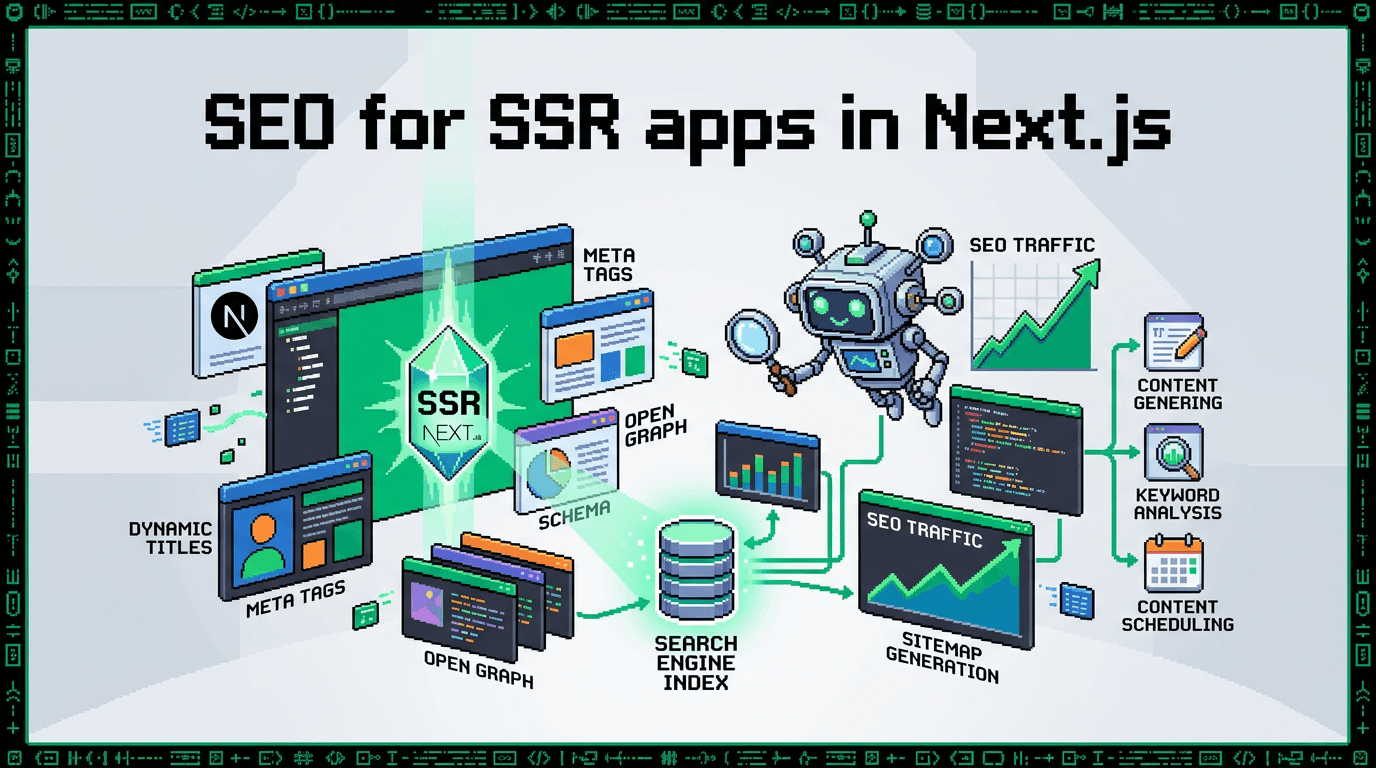
Modern React apps live or die by search. Server side rendering gives you control over crawlable HTML, but great rankings still depend on consistent metadata, schema, sitemaps, and internal links that ship with every release.
This guide shows developers how to implement SEO for SSR applications in Next.js. It is for teams building SaaS sites and blogs on React who need reliable, production SEO. The key takeaway: treat SEO as code. Centralize metadata, schema, sitemaps, and linking in a governed pipeline so every page ships search ready.
Why SEO for SSR applications matters
SSR outputs HTML that crawlers can parse without waiting for client side hydration. That advantage only pays off if core SEO elements are complete, correct, and consistent.
Crawlability and rendering
- SSR returns fully rendered HTML for titles, meta tags, and content.
- Headless browsers are no longer required for critical content.
- CLS and TTFB still matter. Keep server response fast and predictable.
Consistency at scale
- Manual per page edits drift over time.
- Centralized helpers prevent missing canonical tags or robots mistakes.
- Tests and linting catch regressions before deploy.
Core Next.js SEO building blocks
Next.js provides primitives to ship stable, SEO friendly markup without reinventing the stack.
Titles and meta with the Metadata API
- Use the app router Metadata API for predictable document head output.
- Generate canonical URLs from runtime config to avoid environment drift.
// app/blog/[slug]/page.tsx
import { Metadata } from 'next';
import { getPostBySlug } from '@/lib/content';

export async function generateMetadata({ params }): Promise<Metadata> {
  const post = await getPostBySlug(params.slug);
  const url = `https://example.com/blog/${post.slug}`;
  return {
    title: post.title,
    description: post.excerpt,
    alternates: { canonical: url },
    openGraph: {
      title: post.title,
      description: post.excerpt,
      type: 'article',
      url,
      images: post.ogImage ? [post.ogImage] : [],
    },
    twitter: {
      card: 'summary_large_image',
      title: post.title,
      description: post.excerpt,
      images: post.ogImage ? [post.ogImage] : [],
    },
    robots: { index: true, follow: true },
  };
}
Robots and canonical control
- Always set a single canonical per route.
- Block non canonical duplicates like paginated variants via meta robots or rel prev/next when needed.
export const dynamic = 'force-static'; // prefer stable HTML for blogs
export const revalidate = 60 * 60; // ISR for freshness without churn
Programmatic SEO in a Next.js codebase
Programmatic SEO means defining templates and data sources that output many pages with validated SEO elements.
Template driven page generation
- Define route generators that map data rows to pages.
- Centralize metadata rules in a utility so every page inherits consistent tags.
// lib/seo.ts
import type { Metadata } from 'next';

export function buildPageMetadata({
  title,
  description,
  path,
  ogImage,
}: { title: string; description: string; path: string; ogImage?: string }): Metadata {
  const url = `https://example.com${path}`;
  return {
    title,
    description,
    alternates: { canonical: url },
    openGraph: { title, description, url, images: ogImage ? [ogImage] : [] },
    twitter: { card: 'summary_large_image', title, description, images: ogImage ? [ogImage] : [] },
  };
}
Content sources and governance
- Pull structured content from a headless DB, CMS, or JSON files.
- Add a publish status flag and review gate before routes build.
- Validate fields on CI to catch missing titles or duplicate slugs.
Sitemaps and index hygiene
Sitemaps guide discovery. In SSR apps, generate them at build or on demand to match what you actually serve.
Building a dynamic sitemap route
// app/sitemap.ts
import { MetadataRoute } from 'next';
import { listAllPublicUrls } from '@/lib/urls';

export default async function sitemap(): Promise<MetadataRoute.Sitemap> {
  const items = await listAllPublicUrls();
  return items.map((u) => ({ url: `https://example.com${u.path}`, lastModified: u.updatedAt }));
}
Multiple sitemaps and images
- Split large sites into index + child sitemaps by type.
- Include image and video sitemaps for media heavy pages.
- Update on schedule or ISR to keep modification times fresh.
Schema markup for Next.js and React
Structured data helps search engines understand content types. Output JSON LD server side with stable keys.
Article and BlogPosting
// components/JsonLd.tsx
export function JsonLd({ data }: { data: object }) {
  return (
    <script
      type="application/ld+json"
      dangerouslySetInnerHTML={{ __html: JSON.stringify(data) }}
    />
  );
}

// usage in a blog page
<JsonLd
  data={{
    '@context': 'https://schema.org',
    '@type': 'BlogPosting',
    headline: post.title,
    description: post.excerpt,
    datePublished: post.publishedAt,
    dateModified: post.updatedAt,
    author: { '@type': 'Person', name: post.author },
    mainEntityOfPage: `https://example.com/blog/${post.slug}`,
    image: post.ogImage ? [post.ogImage] : undefined,
  }}
/>
Product and SaaS landing pages
- For pricing or feature pages, use Product, SoftwareApplication, or Organization schema.
- Keep fields truthful and consistent with on page content.
Internal linking automation
Links help distribute authority and improve discovery. Automate related links to reduce manual toil.
Related posts and topic hubs
- Maintain a tag taxonomy and generate related links based on shared tags.
- Show 3 to 5 related links at the end of each article.
// components/RelatedLinks.tsx
export function RelatedLinks({ currentId, tags }: { currentId: string; tags: string[] }) {
  const related = getRelatedByTags(currentId, tags).slice(0, 5);
  if (!related.length) return null;
  return (
    <nav aria-label="Related">
      <ul>
        {related.map((p) => (
          <li key={p.slug}><a href={`/blog/${p.slug}`}>{p.title}</a></li>
        ))}
      </ul>
    </nav>
  );
}
Canonical safe cross posting
- If you cross post to other platforms, set a canonical back to the primary URL.
- Keep slugs and titles aligned to avoid index fragmentation.
For teams that also need expert consulting on site architecture or migrations, consider working with a technical partner who builds custom web experiences. Many teams rely on specialists like the ones at Bayline Digital for complex website development initiatives.
Performance and rendering checks
Performance signals influence crawl budget and user experience. Bake checks into CI.
Server metrics and caching
- Monitor TTFB and cache hit ratios.
- Use ISR or full page caching where safe, and tag revalidation by content type.
Client hydration and CLS
- Avoid layout shifts by sizing images and reserving space for dynamic modules.
- Lazy load below the fold assets and ship critical CSS.
A practical Next.js SEO checklist
Use this quick list during implementation and code review.
Route level items
- generateMetadata returns title, description, canonical.
- Open Graph and Twitter tags are present with images.
- Robots and indexing rules are correct for the environment.
Site level items
- sitemap.ts returns current URLs with lastModified.
- robots.txt is environment aware.
- JSON LD is present on templates with correct types.
Tooling options and tradeoffs
Different stacks can handle content, metadata, and automation. Here is a concise comparison of common approaches.
Below is a quick table comparing typical options developers evaluate.
| Approach | Where content lives | Metadata control | Schema output | Best for |
|---|---|---|---|---|
| Files plus code | Markdown or MDX in repo | Centralized helpers | Components or utilities | Small to medium blogs |
| Headless CMS | Remote API | Model fields and webhooks | Mapped fields to JSON LD | Teams with editors |
| Programmatic SEO pipeline | Database plus templates | Code enforced rules | Generated per template | Large catalogs |
Automating your publishing workflow
Automating edits to meta, schema, and links reduces drift and speeds shipping.
CI and validation
- Add tests that fail builds when description, canonical, or og image are missing.
- Lint for duplicate slugs and disallow unsafe robots rules on production.
Scheduled generation and revalidation
- Queue content jobs that write or update MDX and trigger ISR.
- Keep an audit trail of changes and publish approvals in git or a database.
Example: end to end blog route setup
This sketch ties together routing, metadata, schema, and related links.
// app/blog/[slug]/page.tsx
import { Metadata } from 'next';
import { getPostBySlug, getRelatedByTags } from '@/lib/content';
import { JsonLd } from '@/components/JsonLd';

export async function generateMetadata({ params }): Promise<Metadata> {
  const post = await getPostBySlug(params.slug);
  const url = `https://example.com/blog/${post.slug}`;
  return {
    title: post.title,
    description: post.excerpt,
    alternates: { canonical: url },
    openGraph: { title: post.title, description: post.excerpt, url, images: post.ogImage ? [post.ogImage] : [] },
    twitter: { card: 'summary_large_image', title: post.title, description: post.excerpt, images: post.ogImage ? [post.ogImage] : [] },
  };
}

export default async function Page({ params }) {
  const post = await getPostBySlug(params.slug);
  const related = getRelatedByTags(post.id, post.tags).slice(0, 5);
  return (
    <article>
      <h1>{post.title}</h1>
      <p>{post.body}</p>
      <JsonLd data={{
        '@context': 'https://schema.org',
        '@type': 'BlogPosting',
        headline: post.title,
        description: post.excerpt,
        datePublished: post.publishedAt,
        dateModified: post.updatedAt,
        author: { '@type': 'Person', name: post.author },
        mainEntityOfPage: `https://example.com/blog/${post.slug}`,
      }} />
      <section aria-label="Related">
        <h2>Related reading</h2>
        <ul>
          {related.map((p) => (
            <li key={p.slug}><a href={`/blog/${p.slug}`}>{p.title}</a></li>
          ))}
        </ul>
      </section>
    </article>
  );
}
Common pitfalls to avoid
- Forgetting canonical tags on dynamic routes and filtered lists.
- Returning different titles between server and client which triggers head flicker.
- Shipping empty descriptions or duplicating the same excerpt across many pages.
- Overusing noindex in staging and leaking that config into production.
When to use automation tools
If your team needs consistent programmatic seo content with automatic metadata, schema, sitemaps, and internal linking, consider a developer focused automation pipeline. Look for SDKs that integrate with Next.js, support deterministic outputs, and let you validate before publishing. Tie the workflow into CI, approvals, and audit logs so you can ship daily without regressions.
Key Takeaways
- Treat SEO as code in SSR apps with centralized helpers and tests.
- Use Next.js Metadata API, dynamic sitemaps, and JSON LD components.
- Automate internal links and canonical safe cross posting.
- Add CI validation, ISR, and audit trails to reduce drift.
- Choose tools that integrate natively with Next.js for reliable workflows.
Ship a baseline first, then iterate. Small, consistent improvements compound into stable search performance.
Frequently Asked Questions
- What is the best way to set metadata in Next.js?
- Use the app router Metadata API. Generate titles, descriptions, and canonical URLs per route in generateMetadata for server rendered stability.
- How do I add JSON LD schema in a Next.js app?
- Render a script tag with type application/ld+json server side. Build a small JsonLd component that injects a serialized object.
- Should I use ISR for blogs?
- Yes. ISR gives static like speed with scheduled revalidation. Set revalidate for freshness and trigger on content updates.
- How do I prevent duplicate content when cross posting?
- Set a canonical tag to your primary URL, align slugs and titles, and avoid publishing full duplicates without canonicalization.