Examples of Programmatic SEO for Next.js Apps
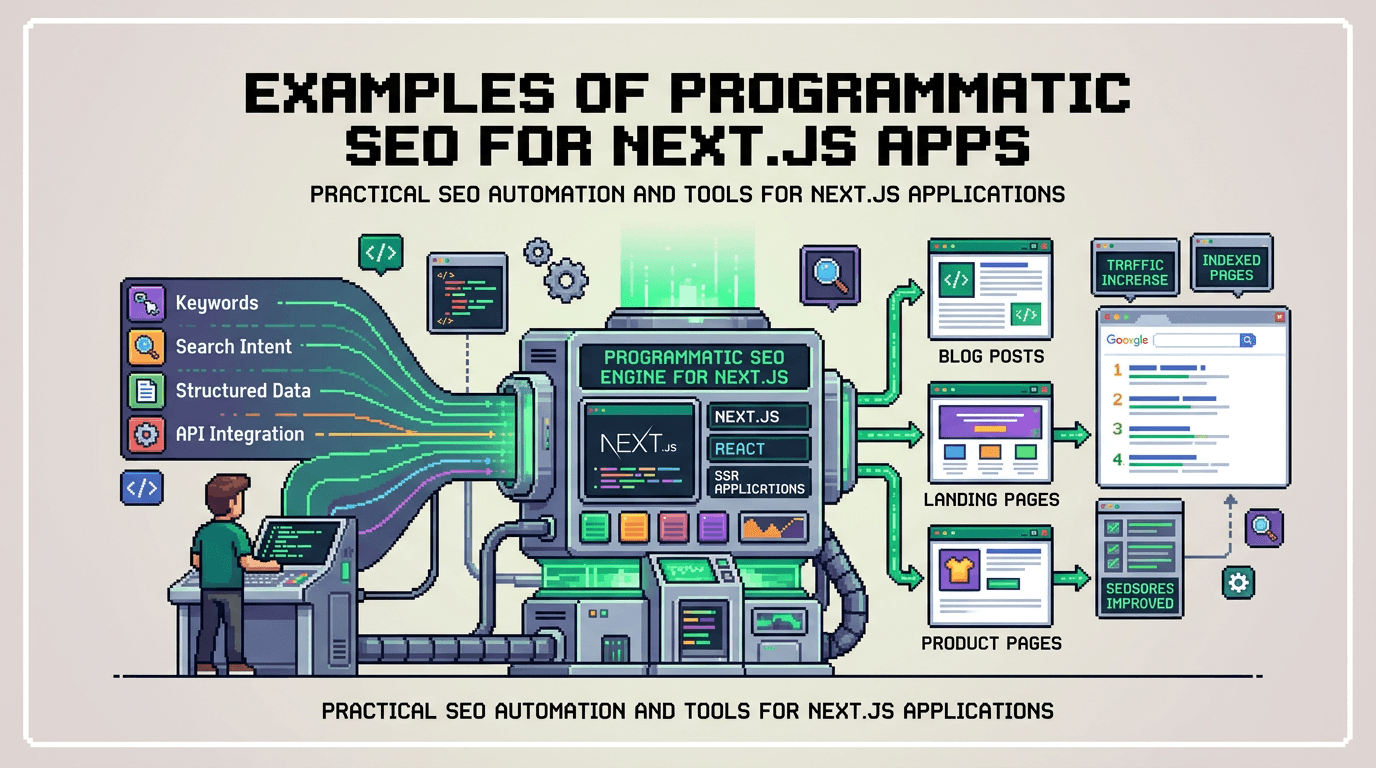
Programmatic SEO lets you turn structured data and repeatable patterns into hundreds or thousands of high quality pages without manual writing. In Next.js, that power compounds when you pair SSR, metadata APIs, and automated publishing.
This guide walks Next.js and React developers through practical programmatic SEO examples, complete code patterns, and an automation blueprint. If you build SEO surfaces in SSR apps, the key takeaway is simple: design a data model, generate pages deterministically, and enforce metadata, schema, and internal linking at build or request time.
What is Programmatic SEO in a Next.js Context
Programmatic SEO is a methodology for creating and maintaining large sets of search-focused pages from a structured data source. In Next.js, it maps cleanly to data fetching, dynamic routes, and server components.
Core building blocks
- Structured data source: database, headless CMS, or JSON files
- Deterministic URL model: slug rules to prevent collisions and duplicates
- Metadata and schema generation: computed from the same record
- Rendering strategy: SSG, ISR, or SSR based on data volatility
- Internal linking graph: auto generated lists, related links, and breadcrumbs
Benefits for React and SSR apps
- Repeatable quality: one template, many pages with uniform SEO hygiene
- Fast iteration: change a template or schema once, improve all pages
- Safer scaling: enforce canonicals, schema, and links at the framework layer
- Operational automation: schedule, publish, and revalidate with minimal toil
Programmatic SEO Examples You Can Ship This Week
Below are concrete examples framed for Next.js with patterns you can lift into production.
Example 1: City and Service Pages for a SaaS Directory
Use a service x location matrix to generate landing pages like /services/crm-consulting/seattle.
1) Data model
- Service: { id, name, slug, description }
- City: { id, name, slug, state, geo }
- Page: cross product computed at build time with rules to skip empty markets
2) Route definition
- Dynamic segment: app/services/[service]/[city]/page.tsx
- Generate static params from your matrix
3) Metadata and schema
- Title:
${service.name} in ${city.name} - Description: concise value and proof points
- BreadcrumbList and LocalBusiness or Service schema with geo when relevant
4) Internal links
- Related cities for the same service
- Related services in the same city
Code sketch for params and metadata:
// app/services/[service]/[city]/page.tsx
import { Metadata } from 'next'
import { getServices, getCities, getPageRecord } from '@/lib/data'

export async function generateStaticParams() {
  const services = await getServices()
  const cities = await getCities()
  return services.flatMap(s => cities.map(c => ({ service: s.slug, city: c.slug })))
}

export async function generateMetadata({ params }): Promise<Metadata> {
  const rec = await getPageRecord(params.service, params.city)
  const title = `${rec.service.name} in ${rec.city.name}`
  const description = `Hire ${rec.service.name} experts in ${rec.city.name}. Pricing, availability, and reviews.`
  const url = `https://example.com/services/${rec.service.slug}/${rec.city.slug}`
  return {
    title,
    description,
    alternates: { canonical: url },
    openGraph: { title, description, url },
    twitter: { title, description }
  }
}
Example 2: Product Feature x Industry Use Cases
Create pages that explain how specific features solve problems in distinct industries. Example: /use-cases/logging/fintech.
- Data: features, industries, proof snippets, case studies
- Template: problem framing, solution steps, implementation pseudo code
- Schema: FAQPage for common questions, HowTo if steps are explicit
- Links: feature docs, customer stories, related industries
Example 3: Programmatic Comparison Pages
Generate X vs Y comparisons from a single schema to ensure fairness and consistency.
- Data: canonical entity attributes, pros, cons, pricing ranges
- Schema: Product or SoftwareApplication plus BreadcrumbList
- UX: concise tables, transparent criteria, CTA to documentation
A minimal table pattern helps readers scan:
Here is a compact comparison table that uses standardized criteria.
| Criterion | Tool A | Tool B |
|---|---|---|
| Pricing model | Per seat | Flat tier |
| Ideal team size | 1 to 20 | 10 to 200 |
| Core strength | Simplicity | Extensibility |
| Notable gap | No SSO | Slower setup |
Example 4: Template Catalogs and Pattern Libraries
If your product provides templates, expose them as indexable pages with consistent fields.
- Route: /templates/[category]/[template]
- Schema: CreativeWork or SoftwareSourceCode when applicable
- Metadata: title from template name, include category, version, compatibility
- Assets: previews and code blocks rendered with MDX
Example 5: Aggregated Best Lists Backed by Evidence
Programmatic best lists work when criteria are objective and traceable.
- Data: signals like GitHub stars, weekly downloads, security flags
- Method: normalize metrics and rank deterministically
- Schema: ItemList with ListItem entries and positions
Architecture Patterns for Next.js Programmatic SEO
You need predictable routes, deterministic metadata, and a controlled revalidation story. These patterns keep the surface stable as you scale.
Routing and rendering strategy
- Prefer static generation for content that changes rarely
- Use ISR for listings or lightly dynamic pages
- Use SSR for private or fast changing data
// app/[entity]/[slug]/page.tsx
export const revalidate = 86400 // 1 day ISR
Deterministic slugs with conflict guards
- Normalize strings, strip stop words, and include ids when necessary
- Store a slug history table to emit 301s on rename
export function toSlug(name: string, id?: string) {
  const base = name.toLowerCase().replace(/[^a-z0-9]+/g, '-').replace(/(^-|-$)/g, '')
  return id ? `${base}-${id.slice(0,6)}` : base
}
Data access and hydration boundaries
- Fetch data in server components only
- Serialize minimal props when you must render client components
- Keep expensive joins in the server layer
// app/use-cases/[feature]/[industry]/page.tsx
import { getUseCase } from '@/lib/data'

export default async function Page({ params }) {
  const data = await getUseCase(params.feature, params.industry)
  return <UseCasePage data={data} />
}
Metadata, Schema, and Sitemaps With the Next.js Metadata API
Programmatic SEO rises or falls on consistent metadata. Next.js provides a typed API that you should centralize.
Centralized metadata factory
Build a single helper that returns complete metadata from a record.
// lib/seo.ts
import { Metadata } from 'next'

export function buildMetadata({ title, description, canonical, images }): Metadata {
  return {
    title,
    description,
    alternates: { canonical },
    openGraph: { title, description, url: canonical, images },
    twitter: { card: 'summary_large_image', title, description }
  }
}
Entity specific generators
Compose the factory with specific field mappers per entity.
// app/services/[service]/[city]/metadata.ts
import { buildMetadata } from '@/lib/seo'

export async function generateMetadata({ params }) {
  const rec = await fetchRecord(params)
  return buildMetadata({
    title: `${rec.service.name} in ${rec.city.name}`,
    description: rec.summary,
    canonical: `https://example.com/services/${rec.service.slug}/${rec.city.slug}`,
    images: [rec.ogImage]
  })
}
Structured data helpers
Emit JSON-LD from the same record shape to prevent drift.
// components/JsonLd.tsx
export function JsonLd({ data }: { data: object }) {
  return (
    <script type="application/ld+json" dangerouslySetInnerHTML={{ __html: JSON.stringify(data) }} />
  )
}
// usage inside a page component
import { JsonLd } from '@/components/JsonLd'
<JsonLd data={{
'@context': 'https://schema.org',
'@type': 'Service',
name: rec.service.name,
areaServed: rec.city.name,
url: `https://example.com/services/${rec.service.slug}/${rec.city.slug}`
}} />Programmatic sitemaps
Generate hierarchical sitemaps from your data to keep crawl paths fresh.
// app/sitemap.ts
import { MetadataRoute } from 'next'
import { allUrls } from '@/lib/urls'

export default async function sitemap(): Promise<MetadataRoute.Sitemap> {
  const urls = await allUrls()
  return urls.map(u => ({ url: u, changefreq: 'weekly', priority: 0.7 }))
}
Internal Linking and Canonical Safety at Scale
Large surfaces need predictable internal links and duplication controls.
Internal link graph rules
- Always link from entity pages to their parent indexes
- Add related entities based on tags, category, or geography
- Use consistent anchor text patterns and avoid stuffing
export function relatedLinks(entity, all) {
  return all
    .filter(e => e.category === entity.category && e.slug !== entity.slug)
    .slice(0, 5)
    .map(e => ({ href: `/${e.category}/${e.slug}`, label: e.name }))
}
Canonicals and duplicates
- Emit a single canonical for each entity page
- When cross posting to other platforms, set rel canonical to the primary
- Use hreflang when serving regional variants
Breadcrumbs and collections
Use BreadcrumbList schema to show hierarchy and power sitelinks.
<JsonLd data={{
  '@context': 'https://schema.org',
  '@type': 'BreadcrumbList',
  itemListElement: [
    { '@type': 'ListItem', position: 1, name: 'Services', item: 'https://example.com/services' },
    { '@type': 'ListItem', position: 2, name: rec.service.name, item: `https://example.com/services/${rec.service.slug}` },
    { '@type': 'ListItem', position: 3, name: rec.city.name, item: `https://example.com/services/${rec.service.slug}/${rec.city.slug}` }
  ]
}} />
Execution Automation With a Publishing Pipeline
Building the pages is half the job. Reliability comes from automation that enforces SEO rules and a steady cadence.
Queue, validate, publish
- Step 1 validate: schema checks, metadata completeness, slug uniqueness
- Step 2 queue: schedule timestamps, idempotent job keys
- Step 3 publish: write records, trigger ISR revalidation, post to social if needed
// pseudo job
await validate(record)
await enqueue({ key: `pub:${record.id}`, runAt: record.publishAt })
// worker
if (alreadyPublished(key)) return
await upsert(record)
await revalidatePath(record.path)
markPublished(key)
Choosing rendering modes per surface
- Evergreen reference pages: SSG with rare revalidation
- Inventory or pricing: ISR with short windows
- Personalized dashboards: SSR without indexing
Observability and rollback
- Store publish artifacts and metadata snapshots
- Provide a one click rollback that restores the prior version
- Emit webhooks or logs to your incident channel on failures
A Minimal Next.js Starter for Programmatic SEO
Here is a compact starter structure that demonstrates the patterns above.
app/
  services/[service]/[city]/page.tsx
  use-cases/[feature]/[industry]/page.tsx
  sitemap.ts
components/
  JsonLd.tsx
  RelatedLinks.tsx
lib/
  data.ts         # typed fetchers
  seo.ts          # metadata builders
  urls.ts         # url emitters for sitemap
  slug.ts         # deterministic slugs
  publish.ts      # queues and revalidation
Core implementation snippets:
// lib/data.ts
type Service = { id: string; name: string; slug: string }
type City = { id: string; name: string; slug: string }

export async function getServices(): Promise<Service[]> { /* ... */ return [] }
export async function getCities(): Promise<City[]> { /* ... */ return [] }
export async function getPageRecord(serviceSlug: string, citySlug: string) { /* ... */ }
// components/RelatedLinks.tsx
export function RelatedLinks({ links }: { links: { href: string; label: string }[] }) {
if (!links?.length) return null
return (
<ul>
{links.map(l => (
<li key={l.href}><a href={l.href}>{l.label}</a></li>
))}
</ul>
)
}When to Use SSG, ISR, or SSR for Programmatic SEO
Your choice affects crawl freshness, cache hit rates, and ops cost.
Use SSG when
- The data is stable for weeks or months
- You want highest performance with zero runtime data calls
- You can rebuild on schedule after bulk updates
Use ISR when
- Data changes periodically but predictably
- You want CDN performance with timed freshness
- You need low effort rollouts after edits
Use SSR when
- Content depends on request headers or auth
- You need real time data that cannot be cached
- The page should not be indexed or should be noindex
Here is a compact decision matrix you can adapt.
| Factor | SSG | ISR | SSR |
|---|---|---|---|
| Freshness needs | Low | Medium | High |
| Performance | Excellent | Excellent | Variable |
| Complexity | Low | Medium | High |
| Indexability | Yes | Yes | Usually no |
Realistic Pitfalls and How to Avoid Them
Programmatic SEO at scale fails more from governance than code.
Duplicate pages and cannibalization
- Enforce one intent per URL with a canonical registry
- Block auto generation when fields are too thin to rank
Schema drift
- Unit test JSON-LD output against a contract
- Validate in CI for required properties
Thin or repetitive copy
- Compose copy from multiple fields rather than repeating entity names
- Include examples, steps, or small snippets to add utility
Broken internal links
- Generate links from a single source of truth
- Run a nightly link checker and alert on 4xx/5xx
How AutoBlogWriter Fits Into a Next.js Programmatic SEO Stack
If you prefer not to wire all of this by hand, AutoBlogWriter provides a developer first pipeline for SSR apps.
What it automates
- SEO metadata and schema generation from records
- Sitemaps and internal linking across large surfaces
- Validate to draft to schedule to publish with deterministic outputs
How it integrates with your code
- Next.js SDK to fetch posts and compute metadata
- Drop in React components for lists and post pages
- Zero touch publish queues that trigger ISR revalidation
Example integration outline:
// src/routes/blog/[slug].tsx
import { fetchBlogPost, generatePostMetadata } from '@autoblogwriter/sdk'
import { BlogPost } from '@autoblogwriter/sdk/react'

export async function generateMetadata({ params }) {
  return generatePostMetadata(params.slug)
}

export default async function Page({ params }) {
  const post = await fetchBlogPost(params.slug)
  return <BlogPost post={post} />
}
A short comparison shows where a toolkit helps versus building everything yourself.
Here is a quick build vs buy table for the core workflow.
| Capability | DIY in Next.js | AutoBlogWriter |
|---|---|---|
| Metadata builders | Hand code per entity | Generated from records |
| Schema JSON-LD | Manual helpers and tests | Automatic and validated |
| Sitemaps | Custom emitters | Built in generation |
| Internal links | Your own graph logic | Automated across posts |
| Publish queue | Build workers | Deterministic pipeline |
Key Takeaways
- Programmatic SEO turns structured data into scalable pages with consistent quality.
- In Next.js, pair dynamic routes with centralized metadata, schema, and sitemaps.
- Use SSG or ISR for most public surfaces and enforce a canonical per intent.
- Automate validation, publishing, and revalidation to avoid drift and regressions.
- Tools like AutoBlogWriter can provide deterministic pipelines if you prefer not to build from scratch.
Ship a small pilot surface first, prove the template, then scale to your full dataset with confidence.
Frequently Asked Questions
- What is programmatic SEO?
- A method to generate many high quality pages from structured data using consistent templates, metadata, schema, and internal links.
- Does programmatic SEO work with Next.js?
- Yes. Use dynamic routes, the Metadata API, SSG or ISR for rendering, and JSON-LD helpers to scale pages safely.
- How do I choose between SSG, ISR, and SSR?
- Pick SSG for stable content, ISR for periodic updates with CDN speed, and SSR for real time or private pages that should not index.
- How do I prevent duplicate content?
- Enforce a single canonical per intent, block thin pages, use hreflang for regional variants, and maintain 301s on slug changes.
- Can I automate metadata and sitemaps?
- Yes. Centralize metadata builders, emit JSON-LD from the same record, and generate sitemaps from your URL registry or data source.