Auto Publish SEO Blog Posts with AI in SSR React Apps
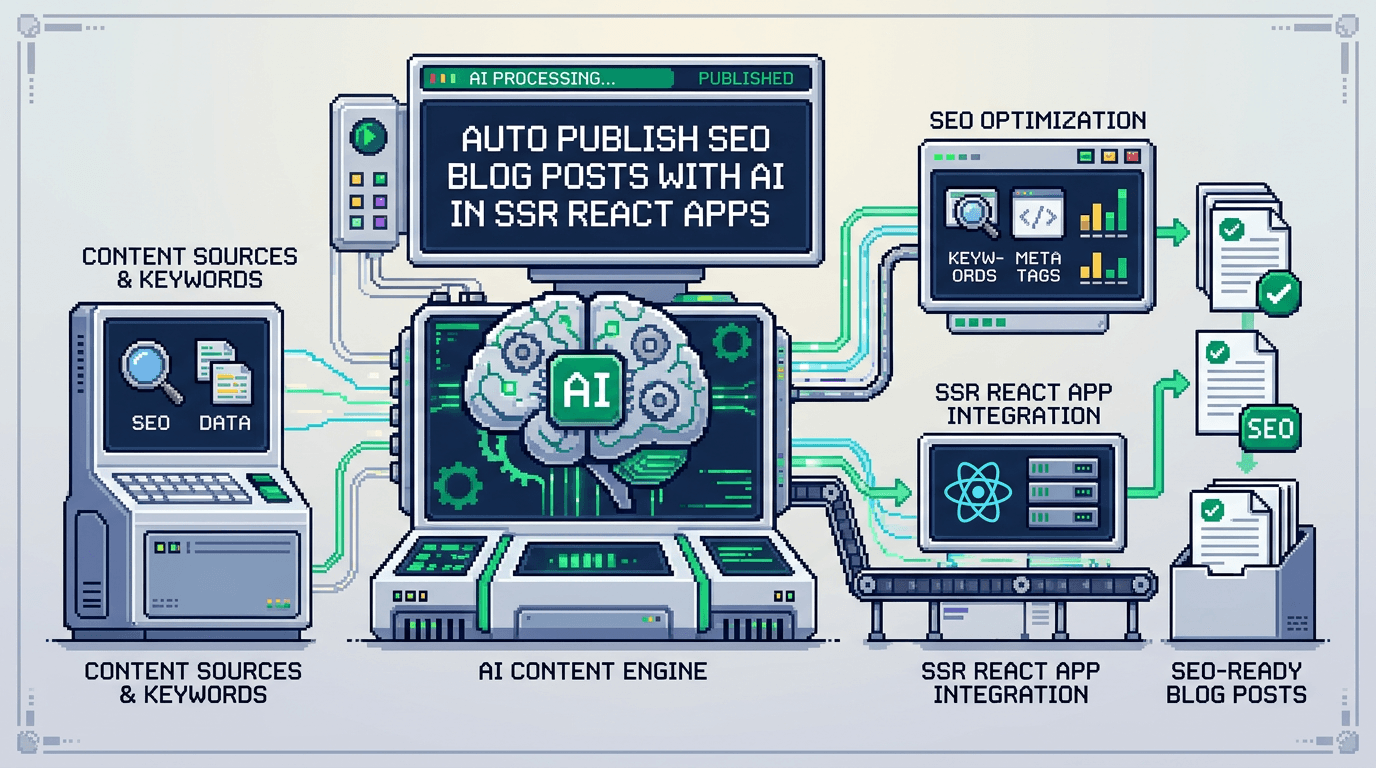
Ship your next SEO post while you sip coffee. With the right developer workflow, you can auto publish SEO blog posts with AI in SSR React apps and keep metadata, schema, and sitemaps consistent without manual toil.
This guide shows developers and fast-moving SaaS teams how to build an automated blog pipeline that generates, validates, and ships production-ready content on a schedule. You will learn an agentic SEO workflow, SSR React integration patterns, and governance that prevents regressions. Key takeaway: treat SEO publishing as code so your AI pipeline is zero touch and always production safe.
Why automate your SEO blog pipeline
Modern SEO is execution heavy. Teams fail not from strategy, but from missed details at publish time. Automating the pipeline fixes that by enforcing standards and cadence.
The cost of manual SEO plumbing
- Inconsistent titles, descriptions, and og tags cause CTR drops and rework.
- Missing or invalid schema erodes rich result eligibility.
- Forgotten sitemap updates delay discovery and indexing.
- Untracked internal linking leaves orphaned pages that never compound.
What success looks like
- Deterministic outputs for metadata, schema, and sitemaps on every publish.
- A predictable cadence that Google and readers learn to trust.
- Internal links that automatically connect new posts to key money pages.
- One command or PR merges that move a post from draft to live without manual steps.
Core principles for auto publish SEO blog posts with AI
Bringing AI into your stack does not mean giving up control. These principles ensure quality and reliability.
Execution as code
Codify SEO requirements in your build: metadata contracts, schema validators, and link policies. Failing validation blocks the publish, just like failing tests blocks CI.
Determinism over creativity at publish time
Generation can be flexible, but the publish step must be deterministic. Lock templates for titles, slugs, canonical rules, and schema shapes so outputs are stable.
SSR first, client light
Render metadata and structured data on the server for crawlable, stable output. Use React components that emit static HTML for critical SEO surfaces.
Idempotent, rollback safe workflows
Publishing should be safe to retry. Write operations must be idempotent with clear status states, audit logs, and one-click rollback.
Architecture of an automated blog pipeline for SaaS
A simple, robust design keeps moving parts small and observable.
Components in the pipeline
- Content source: prompts, briefs, or product notes that seed generation.
- Agentic runner: orchestrates Generate → Validate → Draft → Schedule → Publish.
- SEO validator: enforces metadata, schema, and link policies.
- SSR app: React routes and components that render posts, metadata, and lists.
- Indexing layer: sitemap generation and ping, plus ISR or revalidation hooks.
- Governance: approvals, queues, and audit trail.
Data flow from idea to index
- Intake: brief enters the queue with target keyword and internal link intents.
- Generate: content, image, social copy produced in one run with trace metadata.
- Validate: metadata contract, JSON-LD, link graph, and accessibility checks.
- Draft: stored as versioned artifact with diff and preview URL.
- Schedule: assigned time window and idempotent publish token.
- Publish: SSR render, sitemap update, and cache revalidation.
- Monitor: status, logs, and alerts wired to your observability stack.
Wiring the SSR React layer
The SSR layer is where robots and readers meet your output. Keep it simple and typed.
Routes and metadata generation
Below is an example pattern showing how a route loads post data and metadata from an SDK while keeping outputs deterministic.
// src/routes/blog/[slug].tsx
import { fetchBlogPost, generatePostMetadata } from "@autoblogwriter/sdk";
import { BlogPost } from "@autoblogwriter/sdk/react";
import type { SeoMetadata } from "@autoblogwriter/sdk/types";

export async function loadMetadata(slug: string): Promise<SeoMetadata> {
  return generatePostMetadata(slug);
}

export async function renderPostPage({ slug }: { slug: string }) {
  const post = await fetchBlogPost(slug);
  return <BlogPost post={post} />;
}
This keeps metadata generation centralized and consistent. If validation fails, the publish pipeline halts upstream.
Structured data and sitemap automation
- Emit JSON-LD Article schema from the server using a typed helper.
- Generate sitemaps at build or publish time and ping search engines.
- Ensure canonical and og:url match the final resolved path.
- Keep changefreq and priority stable to avoid noisy diffs.
Governance, approvals, and safe scheduling
Automation needs guardrails so teams can move fast without fear.
Approval gates and queues
- Require a green validation suite before human approval.
- Use a single publish queue with FIFO semantics and idempotent tokens.
- Record who approved and when, with diff snapshots.
Rollbacks and retries
- Make publish actions reversible with an atomic unpublish.
- Support retries on network errors without duplicating posts.
- Keep a signed artifact of the exact content and metadata that shipped.
Internal linking automation that compounds
A predictable internal link strategy is a growth flywheel. Automate it.
Link intent and placement rules
- Attach link intents to briefs, targeting cornerstone pages and clusters.
- Insert links in semantically relevant paragraphs with max links per section.
- Enforce dofollow for internal, nofollow for external if policy requires.
Measuring link health
- Track orphaned pages and link depth.
- Alert when cornerstone pages lose inbound links.
- Rebuild related posts blocks using embeddings or tag graphs.
Comparing approaches to automated publishing
Below is a quick comparison of common approaches to building an automated pipeline.
Here is a concise table to weigh build vs buy vs hybrid for developer teams.
| Approach | Speed to live | SEO enforcement | Governance | Dev effort | Fit for |
|---|---|---|---|---|---|
| DIY scripts + cron | Medium | Low | Low | High | Tinkerers |
| Headless CMS + plugins | Medium | Medium | Medium | Medium | Content teams |
| Agentic runner + SSR SDK | Fast | High | High | Low | Dev-first SaaS |
| Zap-based automations | Fast | Low | Low | Low | Prototyping |
If your goal is to auto publish SEO blog posts with AI while keeping outputs deterministic and schema perfect, the agentic runner plus SSR SDK path is the most reliable long term.
Tooling fit: where headless CMS, AI copy tools, and agentic SEO differ
Choosing tooling is about controlling outputs at publish time, not just generating words.
What headless CMS platforms do well
- Content modeling and editorial UIs.
- Media libraries and role permissions.
- Basic scheduling and webhooks.
Where they often fall short for developer SEO:
- Enforcing structured data and sitemaps across versions.
- Deterministic generation of metadata from content source.
- Automated internal linking aligned to product goals.
What AI copy tools do well
- Rapid drafting and ideation.
- Tone adaptation and language corrections.
Gaps for production SEO:
- Limited SSR integration and schema validation.
- No governance over publishing, idempotency, or rollback.
Why a developer-first agentic stack wins for SSR React
An agentic stack centers on a single run that outputs post, image, social copy, metadata, schema, and links in one controlled pass, then publishes safely.
Benefits to developers and SaaS teams
- 5 minute setup in SSR React with drop in components for lists and posts.
- Zero touch validate to publish with deterministic artifacts.
- Built in metadata, JSON-LD, sitemaps, and internal linking.
- Compatible with AI coding assistants that can wire the SDK from spec.
Example zero touch workflow
- Submit brief with target keyword and link intents.
- Agent creates post, hero image, and social copy with trace IDs.
- Validator checks metadata, schema, and link graph.
- Approver signs off; item enqueues for scheduled window.
- Publisher renders SSR page, updates sitemap, and revalidates caches.
Step by step: stand up an automated blog pipeline
A practical path you can implement this week.
1) Define the SEO contract
- Required fields: title, description, slug, canonical, og tags, twitter tags.
- JSON-LD Article schema with author, datePublished, image, and headline.
- Link intents: targets and anchor text constraints.
- Validation rules: max title length, description length, h2 count, and schema presence.
2) Add SSR React components
- Post page component that renders headings, images, code blocks, and CTA.
- Metadata loader that generates tags server side.
- Related posts component driven by link graph or embeddings.
3) Wire the agentic run
- An orchestrator that takes a brief and returns artifacts: post.md, hero.png, social.txt, metadata.json.
- Store artifacts in a versioned bucket or git branch with checks.
- Expose a preview URL that SSR renders from the artifact.
4) Enforce validations in CI
- Lint metadata lengths and disallow missing og:image.
- Validate JSON-LD against a schema.
- Check internal links resolve and are not broken.
- Fail the build if any rule is violated.
5) Schedule and publish safely
- Use a single queue with idempotent publish tokens.
- At publish: write the artifact to your content store, render SSR, update sitemap, and ping.
- Log a signed snapshot of everything that shipped.
6) Observe and iterate
- Emit metrics: time to publish, validator failure rates, broken links.
- Alert on sitemap diffs and missing schema.
- Feed insights back into briefs and link intent planning.
Implementation details developers often miss
Small misses turn into ranking drags. Tighten these details early.
Canonicals and cross posting
- If you mirror content across domains, set a single canonical to the primary.
- Keep slug parity when possible; map redirects if parity is not possible.
- Maintain UTM rules so analytics attribution is consistent.
Image handling
- Generate hero images at a predictable aspect ratio.
- Serve responsive sizes with width and height attributes.
- Include alt text derived from the headline and angle.
Using AI coding assistants to wire the SDK in minutes
AI assistants can bootstrap the integration if you give them a clear spec.
Practical setup
- Add an llms full spec file to your repo with SDK usage and route examples.
- Ask your assistant to implement blog routes, metadata loaders, and a publish webhook.
- Review diffs, run tests, and connect environment secrets.
Guardrails for safe automation
- Never allow unchecked writes in production from a dev agent.
- Require approvals for schedule and publish steps.
- Keep secrets scoped and rotated on a schedule.
Sample policy for internal linking automation
Codify how your pipeline chooses and places links so outputs remain consistent.
Rules worth enforcing
- 3 to 6 internal links per 1500 words, weighted to top clusters.
- Never duplicate the same anchor to the same URL within one post.
- Include at least one link to a product or pricing page when contextually relevant.
Validation checks
- Disallow links to redirected or noindexed pages.
- Cap external links and enforce rel attributes by domain policy.
- Ensure related posts block includes at least one fresh article from the last 90 days.
Minimal checklist before you go live
Here is a quick table you can use for pre launch checks.
| Area | Check | Pass criteria |
|---|---|---|
| Metadata | Title and description lengths | Title 45 to 60 chars, description 140 to 160 chars |
| Schema | JSON LD Article present | Validates against schema, no errors |
| Links | Internal link graph | 3 to 6 links to priority pages, no 404s |
| Sitemap | Inclusion and ping | URL added to sitemap and ping sent |
| Render | SSR output | No client only tags needed for core content |
Key Takeaways
- Treat SEO publishing as code to achieve deterministic, zero touch releases.
- Use SSR React components to render metadata, schema, and content server side.
- Enforce validations, approvals, and idempotent scheduling for reliability.
- Automate internal linking to compound authority across your product pages.
- Start small with a single agentic run that outputs post, image, social, and links.
Ship with confidence. Your automated pipeline will keep working while your team focuses on building product.
Frequently Asked Questions
- What is the fastest way to auto publish SEO blog posts with AI?
- Use an agentic runner with an SSR React SDK that generates content, validates metadata and schema, and publishes via an idempotent queue.
- How do I prevent duplicate content when cross posting?
- Set a single canonical to the primary URL, keep slug parity, and ensure sitemaps reflect the preferred location.
- Should metadata and JSON LD be server rendered?
- Yes. Server render both to ensure crawlable, stable outputs and consistent rich result eligibility.
- How many internal links should a 1500 word post include?
- Aim for 3 to 6 relevant internal links pointing to cornerstone and product pages without repeating the same anchor to the same URL.