Agentic SEO for SSR SEO Automation in React Apps
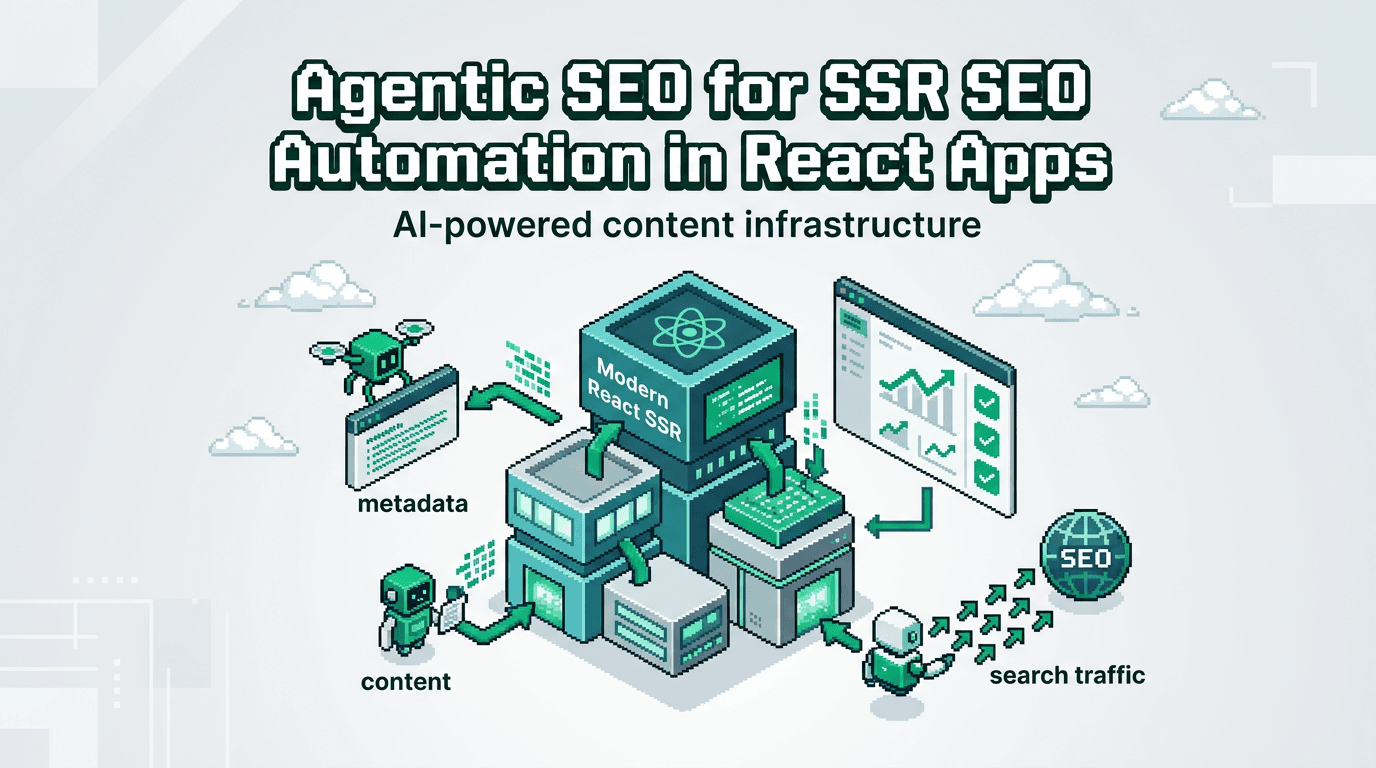
You are one run away from a production blog. With SSR SEO automation, your React app can publish posts with perfect metadata, schema, sitemaps, and internal links without manual wiring.
This guide shows developers and SaaS teams how to implement an agentic, zero-touch blog pipeline for SSR React apps. You will learn how a source-of-truth workflow orchestrates metadata, structured data, sitemap generation, and internal linking automation using drop-in React components and an SDK. Key takeaway: adopt an agentic pipeline so AI agents can plan, generate, validate, schedule, and publish content in one reliable run.
Why SSR SEO Automation Beats Piecemeal Plugins
Modern React apps need consistent metadata, structured data, and a dependable sitemap. SSR SEO automation centralizes these concerns so your pages render with search-ready signals on first paint.
The cost of manual SEO plumbing
- Drift in title, description, and canonical tags across routes
- Missing or broken JSON-LD causing rich result loss
- Forgotten robots meta, hreflang, and pagination hints
- Ad hoc sitemaps that lag behind actual content
What an automated SSR baseline guarantees
- Deterministic metadata for every route at render time
- Validated JSON-LD schemas generated from one source of truth
- Fresh sitemaps emitted on publish, not on a weekly batch
- Predictable internal links that compound topical authority
Agentic Workflows: From Idea to Live in One Run
Agentic SEO is not a single feature. It is an execution model where AI agents coordinate your content pipeline end to end while your app remains the source of truth for data and rendering.
The source-of-truth pattern
- Store intents, constraints, and content states in your workspace
- Let agents read that state to propose topics and outlines
- Validate outputs against schema and governance rules
- Publish through a controlled queue that writes back status
Roles in an agentic pipeline
- Strategy agent: clusters keywords and proposes briefs
- Drafting agent: produces a technical draft with anchors
- Validation agent: enforces metadata, schema, links, style
- Publisher: schedules, updates sitemap, triggers revalidation
React SEO Metadata Automation That Never Drifts
React teams often juggle layout-level tags and route-level overrides. With SSR SEO automation, one SDK function composes everything deterministically.
Deterministic metadata
- Central function derives title, description, canonical, and robots
- Environment-aware defaults for staging vs production
- Guardrails to prevent empty or duplicate titles
Schema and open graph parity
- JSON-LD generated from the same canonical data as meta tags
- Twitter and Open Graph fetched from a single typed source
Structured Data and Sitemaps Without Cron Jobs
Your sitemap should match content the moment it is published. Automation treats sitemaps as a first-class output, not an afterthought.
Schema automation
- Article schema with author, datePublished, and headline
- BreadcrumbList computed from route segments
- FAQPage and HowTo emitted only when content is compliant
Sitemap generation automation
- Regenerate and ping upon publish or schedule execution
- Split sitemaps by type when large, with proper lastmod
Internal Linking Automation That Builds Authority
Internal links signal topical clusters and distribute PageRank. An agentic pipeline chooses anchor text and placement at draft time and validates it before publish.
Link graph as data
- Maintain a map of entities, slugs, and preferred anchors
- Enforce link quotas per section to avoid stuffing
Smart placement rules
- Insert links near first mention of a concept
- Include one related reading and one deep reference per post
Drop-in React Blog Components and SDK
You do not need a CMS to ship a production blog. A React blog SDK with server utilities and components gives you SSR-safe rendering, metadata, and content hydration.
Core server utilities
- fetchBlogPost(slug): returns content plus metadata payload
- generatePostMetadata(slug): typed SEO object for the route
Page and list components
- <BlogPost />: renders article, table of contents, and schema
- <BlogList />: paginated lists with internal link hooks
Quickstart: Wire SSR SEO Automation in Minutes
The following outlines the minimal integration to get a live, agentic blog running in a typical SSR React app.
Install and configure
- Add the SDK to your app and set workspace credentials
- Expose a routes convention for /blog/[slug]
- Configure build-time types to ensure deterministic outputs
Render post and metadata
- Implement loadMetadata to return the SEO object
- Implement renderPostPage to return the <BlogPost /> component
// src/routes/blog/[slug].tsx
import { fetchBlogPost, generatePostMetadata } from "@autoblogwriter/sdk";
import { BlogPost } from "@autoblogwriter/sdk/react";
import type { SeoMetadata } from "@autoblogwriter/sdk/types";

export async function loadMetadata(slug: string): Promise<SeoMetadata> {
  return generatePostMetadata(slug);
}

export async function renderPostPage({ slug }: { slug: string }) {
  const post = await fetchBlogPost(slug);
  return <BlogPost post={post} />;
}
Orchestrating the Agentic Run
With the SDK in place, connect the workflow so each publish updates metadata, schema, internal links, and sitemaps in one pass.
Validate, then publish
- Validate structured data against a schema contract
- Reject drafts without required anchors and assets
- Only then schedule to the publish queue
Deterministic outputs and audit trail
- Persist checksums of content and metadata
- Idempotent publishes prevent duplicates on retries
- Record sitemap and revalidation events for debugging
Governance and Safety for Fast-Growing Teams
As your cadence increases, governance prevents regressions that hurt crawl quality.
Approval gates
- Require review for new clusters or high-impact pages
- Enforce style and link density rules before merging
Rollback and revalidation
- One-click unpublish with redirect to canonical fallback
- Trigger ISR or cache revalidation on rollback
Comparing Approaches to SSR SEO Automation
Below is a high-level view of three common approaches to building a React blog with SEO at scale.
Approach comparison table to help you choose the right path:
| Approach | Setup time | SEO guarantees | Governance | Best for |
|---|---|---|---|---|
| Hand-rolled SEO + CMS | Weeks | Inconsistent | Manual | Teams with custom editorial systems |
| Plugins and scripts | Days | Partial | Limited | Small sites needing quick fixes |
| Agentic SSR automation | Minutes | Deterministic | Built-in | Dev-led SaaS aiming for scale |
How This Differs From Traditional Tools
Most tools generate content or host it. An agentic pipeline treats your workspace as the source of truth and lets AI agents operate within guardrails, pushing changes through a deterministic SDK.
What competitors optimize for
- Headless CMS: content storage and editorial UI
- WYSIWYG blog platforms: theming and basic SEO helpers
- AI copy tools: draft text generation
What agentic SSR automation optimizes for
- End-to-end execution from strategy to publish
- Validated metadata, schema, internal links, and sitemaps
- Zero-touch scheduling with auditability and safety
Implementation Patterns for Real Apps
Tie the publishing lifecycle to your infrastructure so each state transition updates the right artifacts.
Webhooks and queues
- publish.requested: enqueue job with content checksum
- publish.validated: write metadata, schema, and anchors
- publish.completed: update sitemap, trigger revalidation
Observability
- Log structured events with post ID and version
- Emit metrics for validation failures and retry counts
Extending the Pipeline With Internal Linking Automation
Internal links deserve first-class treatment equal to metadata.
Anchor policy
- Maintain preferred anchors per entity
- Block generic anchors like click here
Context-aware suggestions
- Choose anchors that match the surrounding sentence
- Cap link frequency per 100 words to preserve readability
Frequently Used Data Structures
Agentic pipelines work best when data is typed, versioned, and autovalidated at the edge.
Post record
- slug, title, description, body
- canonical, robots, lastmod
- schema blocks and assets
Link registry
- entityId, preferredAnchor, targetSlug
- usageCount, lastUsedAt
Operational Playbook for Release Day
Keep shipping without surprises by standardizing preflight and postflight tasks.
Preflight checks
- Validate schema and metadata for all scheduled posts
- Dry run sitemap generation and diff lastmod
Postflight checks
- Confirm live metadata and canonical in the HTML
- Crawl the new post to verify internal link placements
Key Takeaways
- Adopt SSR SEO automation to guarantee metadata, schema, sitemaps, and internal links at render time.
- Use an agentic workflow with your app as the source of truth to execute strategy to publish in one run.
- Enforce validation and governance to prevent SEO drift and duplicate content.
- Drop in React blog components and an SDK to ship a production blog in minutes.
- Monitor with queues, checksums, and revalidation hooks for predictable releases.
Agentic SSR automation turns SEO from manual toil into a reliable system that compounds authority with every publish.
Frequently Asked Questions
- What is SSR SEO automation in React apps?
- A server-side workflow that guarantees metadata, schema, sitemaps, and internal links at render time using a deterministic SDK.
- How do agentic workflows differ from AI copy tools?
- Agents orchestrate the entire pipeline from strategy to publish under guardrails, not just draft text generation.
- Do I need a CMS to use this approach?
- No. You can render with a React blog SDK and source-of-truth workspace without a traditional CMS.
- How are sitemaps kept up to date?
- Sitemaps regenerate and ping on publish completion, using lastmod and split files when needed.
- How do you prevent duplicate content?
- By enforcing canonicals, validating internal links, and using idempotent publish queues with checksums.