SSR SEO Automation for React with an Agentic Content Pipeline
If your SSR React app still relies on manual checklists to ship content, you are paying a reliability tax every week.
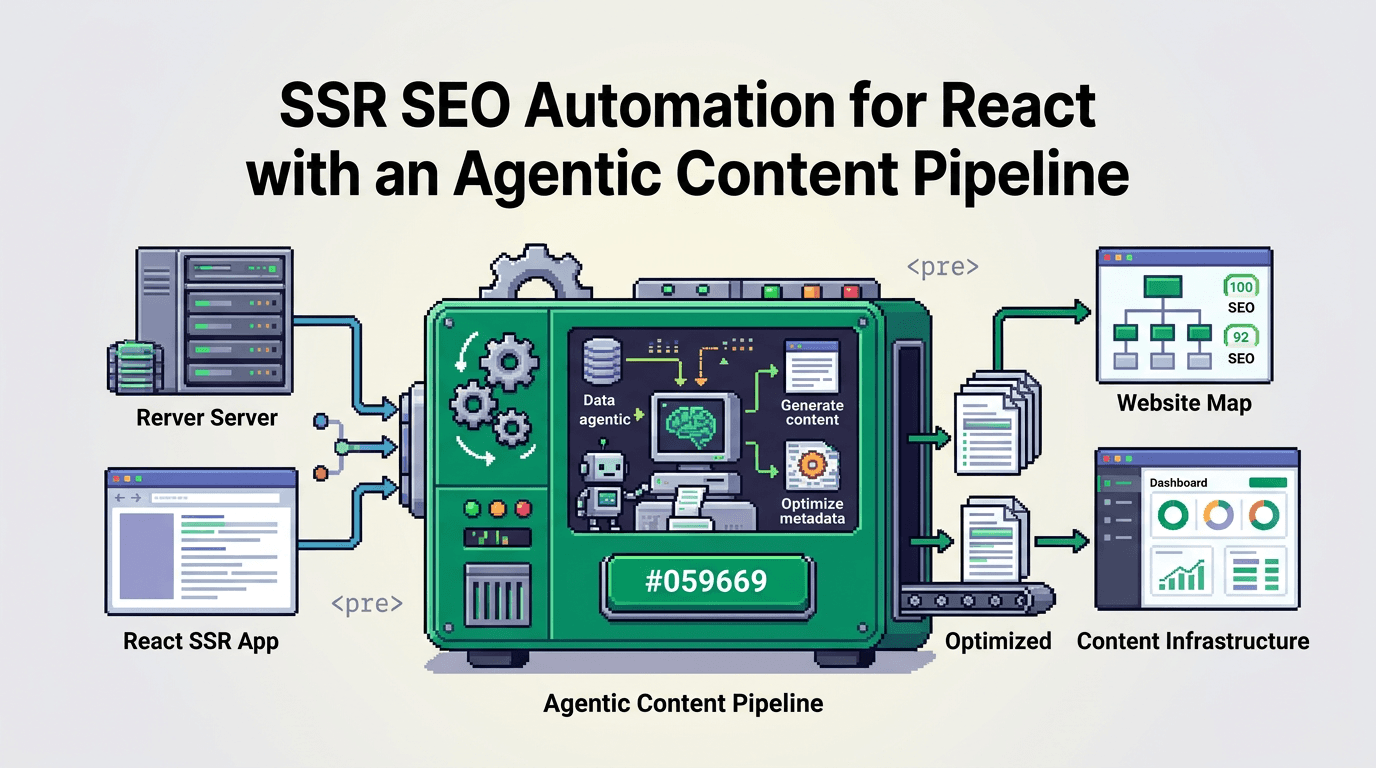
This post shows how SSR SEO automation turns your blog into a zero-touch pipeline that outputs production-ready posts with metadata, schema, sitemap updates, internal links, and assets in minutes. It is for developers and fast-moving SaaS teams. Key takeaway: make an agentic workflow your source of truth so AI agents can create, validate, and publish end to end without a CMS.
Why SSR SEO Automation Matters Now
Modern SSR stacks make pages fast, but SEO execution often lags behind build quality. Automation closes that gap.
The hidden cost of manual metadata
Manually wiring titles, descriptions, canonicals, and Open Graph tags invites drift and regressions. One missed canonical on a cross-post can split equity across URLs, while a forgotten robots tag can deindex a whole post. Automation enforces parity and prevents silent failures.
Structured data and sitemaps at scale
Schema markup and fresh sitemaps help search and AI systems understand your content. When you scale to dozens of posts per month, hand-maintaining JSON-LD and sitemap entries becomes brittle. SSR SEO automation programmatically validates schema and appends sitemap entries in a single, deterministic step.
Agentic Workflows as Your Source of Truth
Most tools generate drafts. An agentic pipeline plans, generates, validates, and ships. Treat it as your content source of truth, not a sidecar.
What makes a workflow agentic
- It can decompose tasks into steps, invoke tools, and verify outputs
- It runs on a governed path from idea to publish on a predictable cadence
- It owns artifacts beyond the post itself, including image, social copy, metadata, schema, sitemap, and internal linking
Why a single source of truth beats scattered scripts
Keeping prompts, spreadsheets, and CI scripts in different places creates unsynced states. Centralizing the plan, content, validations, and publish queue removes ambiguity and aligns your app, docs, and social distribution with one canonical state.
The SSR React Baseline: Components, Metadata, and Internal Links
Before automation, define the minimal building blocks your pipeline will write to.
React blog components and routing
- A canonical list page and a post page component
- Stable slugs and predictable routes, such as /blog/[slug]
- A typed post model including title, excerpt, authorship, tags, hero image, body, and related links
Deterministic SEO metadata generation
- A single function to compute SEO metadata for any slug
- The function must return title, description, canonical, Open Graph, Twitter, and JSON-LD
- The pipeline should call it during build or request time to ensure parity with content state
Automating React SEO Metadata and Schema
Once you expose the metadata function, let the agent fill it with validated values.
Validation rules you should enforce
- Title 50 to 60 chars when possible, unique per URL
- Description 140 to 160 chars, action oriented
- Canonical absolute and consistent with slug
- Open Graph and Twitter images present and correct dimensions
- JSON-LD contains Article markup with headline, author, datePublished, dateModified, and publisher
Schema patterns for articles
- Use Article or BlogPosting with mainEntityOfPage
- Include speakable selectors if relevant to your UI
- Add breadcrumb list schema if you render it server side
- Maintain organization schema with a stable sameAs list
Sitemap Generation Automation for SSR Apps
Your sitemap should reflect what is actually live, not what you intend to publish next week.
Split and prioritize sitemaps
- sitemap.xml index that references blog-sitemap.xml and other sections
- Include lastmod on each entry from your publish timestamp
- Consider changefreq as a hint, but prioritize accurate lastmod
Revalidation and submission
- Trigger sitemap rebuilds on publish, update, or rollback
- Ping search engines on changes and expose a robots.txt link to the index sitemap
- Invalidate edge caches for sitemap routes for near real time freshness
Internal Linking Automation That Compounds
Internal links are how your site distributes authority. Automate them like a graph, not a guess.
Anchor selection and placement logic
- Map target terms to canonical pages and disallow collisions
- Insert links where semantic fit is strong, not only by keyword match
- Enforce max links per section to preserve readability
Governance for link updates
- Version your link graph and allow safe rollbacks
- Recompute related posts as new content lands to keep clusters fresh
- Surface diffs in PRs or logs so engineers can audit placements
Building a Zero Touch Pipeline in an SSR React App
Turn content operations into a single, idempotent run you can call from CLI, CI, or a scheduled job.
Deterministic run outputs
- Markdown body styled to your site via your React components
- SEO metadata JSON and JSON-LD artifacts
- Hero image URL and alt text
- Social copy variants for short channels
- Internal link suggestions and accepted placements
- Sitemap entries with lastmod
Validate then publish
- Validate schema and metadata before writing
- Draft to a staging environment and snapshot assets
- On approval, schedule or publish and write audit logs
- Revalidate ISR or SSR caches and update sitemap index
Agentic SEO in Practice: From Idea to Live in Minutes
Below is a representative flow you can replicate. Keep the run single responsibility and side effect aware.
Plan and extract
- Crawl your site for brand and tone, collect product features and entities
- Select topic based on gaps and internal link opportunities
- Generate outline with target keyword, user intent, and desired internal links
Generate and optimize
- Produce a draft with headings, short hook paragraph, and scannable sections
- Insert code snippets or tables where they help clarity
- Compute SEO metadata and JSON-LD from the draft deterministically
- Validate style, length windows, and link placements
Drop In React Components for Lists and Post Pages
Having reusable, SSR friendly components standardizes rendering and simplifies automation.
What your post component should accept
- A complete Post object with fields for body markdown or AST
- Precomputed metadata and schema to render in the head
- A related posts list and link placement instructions
List and index components
- Render paginated lists with consistent card metadata
- Expose structured data for item lists where applicable
- Accept filters for tags or categories without fracturing URLs
Comparing Agentic Pipelines to Other Approaches
Here is how an agentic, source of truth pipeline compares to popular alternatives.
A quick comparison to frame tradeoffs:
| Approach | Who it fits | Strengths | Risks | Maintenance |
|---|---|---|---|---|
| Agentic SSR SEO automation | Dev led SaaS teams | End to end outputs, validated metadata, schema, sitemap, links | Requires initial setup | Low ongoing, governed |
| Headless CMS only | Content teams with editors | Familiar UI, roles | Manual SEO drift, custom glue code | Medium to high |
| AI copy tool + manual posting | Small teams | Fast drafting | No governance, metadata gaps | High error rate |
| Static generator scripts | Engineering heavy | Full control | Custom maintenance burden | High |
Where Alternatives Fit and How to Decide
Evaluate by execution guarantees, not only drafting speed.
When a CMS centric stack makes sense
- You need non technical editors to manage pages with many content types
- SEO rules are simple and volume is low
- You accept manual metadata and linking reviews for each post
When agentic SSR SEO automation wins
- You want reliable, repeatable outputs that ship in minutes
- Metadata, schema, and sitemaps must be correct by construction
- Internal linking and cadence need to be enforced automatically
Primary Use Cases to Target First
Start where automation produces clear, measurable wins in your SSR React app.
Spin up a production blog without a CMS
Use drop in components and a typed model to render posts and lists. Let the pipeline own content, metadata, schema, and sitemap so you skip building a CMS backend.
Programmatic clusters with internal link governance
Ship product led content around a feature area and let the pipeline propose and enforce links across posts while preserving readability and canonical targets.
Setting Up AI Coding Assistants for Faster Integration
Agentic pipelines get stronger when your AI assistants can read your stack spec directly.
llms full style docs
- Publish a single text spec that describes your SDK, routes, and validation rules
- Point Cursor, Windsurf, or Copilot to it so they can write integration code that matches your conventions
Guardrails and review
- Keep schema tests and metadata checks in CI
- Require approvals on publish actions to maintain governance
Reliability Patterns for Scheduling and Revalidation
Publishing should be idempotent and auditable.
Idempotent scheduling
- Assign a stable publish id to each run
- Retries must not duplicate posts or sitemap entries
- Keep a durable queue with visibility timeouts
Cache, ISR, and search freshness
- Revalidate ISR pages after publish or rollback
- Purge CDN edges for sitemap and feed routes
- Notify search engines with the new sitemap index timestamp
Measuring Impact Without Vanity Metrics
Focus on execution health and discoverability signals.
Execution health SLOs
- 100 percent of posts include valid schema and metadata
- Sitemaps updated within minutes of publish
- Internal link graph updated within the same run
Discoverability and growth
- Track coverage for clusters and canonical pages
- Monitor indexed ratio and rich result eligibility
- Review crawl stats for sitemap fetch regularity
Security, Governance, and Audit Trails
Treat content publishing with the same rigor as releases.
Approval gates and roles
- Separate generate from publish permissions
- Allow scheduled windows and hold publish during incidents
- Record who approved, when, and what changed
Rollback safety
- Keep versioned artifacts with diffs
- Unpublish should restore previous sitemap state and invalidate caches
- Maintain logs for all outbound webhooks and submissions
From Zero to First Live Post in Under Five Minutes
Speed comes from convention over configuration.
Minimal steps
- Install the SDK and mount list and post components
- Expose a metadata function and JSON-LD renderer
- Run the agent once to generate post, image, social copy, and links
- Approve and publish to update sitemaps and revalidate routes
What good looks like
- Consistent titles and descriptions within target windows
- Clean URLs with correct canonicals
- Validated schema and instant sitemap availability
- Internal links that read naturally and map to canonical pages
Key Takeaways
- SSR SEO automation turns content into a governed pipeline that ships production ready posts with metadata, schema, sitemaps, and links
- Agentic workflows serve as the source of truth so AI agents can plan, generate, validate, and publish end to end
- Drop in React components and a typed model standardize rendering and simplify automation
- Enforce validations for metadata and schema, automate sitemaps, and govern internal linking for compounding growth
- Make scheduling idempotent, cache revalidation automatic, and audits first class for reliability
Build it once with guardrails and let the pipeline carry the load so your team can focus on product and strategy.
Frequently Asked Questions
- What is SSR SEO automation in React apps?
- It is a governed pipeline that generates content plus validated metadata, schema, sitemaps, and internal links for SSR pages automatically.
- How do agentic workflows act as a source of truth?
- They own plan, content, validations, and publish state in one run so AI agents can execute end to end without manual steps.
- Will this replace a traditional CMS?
- For blogs with predictable structure, yes. You render directly with React components and let the pipeline manage content artifacts.
- How do I avoid duplicate content when cross posting?
- Set canonical URLs consistently, validate them in the pipeline, and automate internal links to the canonical page.
- What metrics prove the pipeline is healthy?
- Track schema and metadata validity, sitemap freshness, internal link updates per publish, and indexed ratio for target clusters.